Marketing Automation ROI: What to Measure and Why It Matters
Investing in marketing automation is straightforward. Proving what it returns is not. This blog sets out the metrics, attribution models, and pipeline signals that a marketing automation consultant uses to turn automation activity into a clear, defensible picture of ROI.

The role of a marketing automation consultant in defining ROI
Imagine what happens when a lead fills out a form on your website without any automation set up. Someone needs to figure out where the request is coming from, determine how to respond to it, write a response, create a follow-up task, assign it, and go after the lead if there is no response. Each request thus takes the necessary time to process, and that time quickly adds up as the number of leads grows.
With automation, that entire sequence runs without anyone lifting a finger. The form is recognized, the right person receives a notification, a reply is sent immediately, a task is created, and if the lead remains silent, follow-up is automatically initiated. The time savings are real and measurable, and scale directly with the number of incoming leads.
The same logic applies across the entire funnel. A sequence for abandoned carts that recovers a percentage of missed checkouts has a direct impact on revenue. A re-engagement campaign that reduces monthly churn contributes more to annual revenue than many lead generation programs. Automation creates value in every phase. The challenge is to build the infrastructure to consistently capture and report that value.
This is where a marketing automation consultant proves their value. Before any workflow or platform configuration is recommended, the right consultant starts with a diagnostic question: what does ROI actually mean for this company, and how will we measure it? In practice, this requires aligning marketing and sales on shared definitions, reviewing the existing data infrastructure, and determining which metrics are tracked, how, and from which source.
The result is a measurement architecture: a set of agreed-upon KPIs, attribution logic, and reporting structures that enable the linking of automation activity to business results. Everything else — the campaigns, the nurture sequences, the lead scoring models — is built on top of that. With this foundation, the numbers tell a consistent story that both teams can act on.
Attribution: giving credit where it's due
Attribution is the process of assigning credit to the marketing touchpoints that influenced a conversion. In theory, it answers a simple question: what caused this deal to be made? In practice, most B2B purchasing processes consist of multiple interactions, across multiple channels, spread over weeks or months — which makes that question genuinely difficult to answer.
Marketing automation makes it even more complex. Automation often works in the background: nurturing a lead with a series of emails, showing relevant content at the right time, triggering follow-up after an important action. These touchpoints move buyers forward, but rarely appear as the final conversion trigger. Attribution models that prioritize the last interaction systematically undervalue what automation has truly contributed.
Last-touch versus multi-touch attribution
Last-touch attribution assigns all credit to the last interaction before a conversion. It is easy to implement and easy to report, and therefore still common. It is also systematically misleading in complex sales trajectories, where the touchpoint that closed the deal is rarely the same as the one that created the opportunity.
Multi-touch attribution divides the credit across the entire purchase journey. The most commonly used models are linear (equal credit to each touchpoint), time-decay (more credit to interactions closer to the conversion), and U-shaped (heavier weighting on the first and last touchpoint, with the rest distributed across the middle). Each model assumes a different assumption about where in the funnel value is created.
Which attribution model fits your sales cycle?
The right model depends on the length and complexity of your sales cycle. For shorter cycles with few touchpoints, last-touch attribution may suffice. For longer B2B cycles where automation plays a persistent role throughout multiple phases, multi-touch models provide a more accurate picture.
The choice also depends on what you want to learn. If the goal is to understand which channels generate awareness, a first-touch or U-shaped model is more informative. If the goal is to assess nurture performance, time-decay attribution correctly weighs the interactions that are most relevant to that query.
No model is perfectly accurate. The value of a conscious choice lies in making your measurement consistent and your comparisons over time meaningful.
Lifecycle KPIs: the metrics that truly matter
Campaign-level metrics give you an incomplete picture of the ROI of marketing automation. Open rates and click-through rates reflect activity, not impact. The KPIs that matter are the KPIs that track how automation affects buyer progress and revenue results across the entire customer lifecycle.
The core metrics to capture are cost per acquisition (CPA), the lead-to-customer conversion rate, the length of the sales cycle, and customer lifetime value (CLV). Together they link automation activity to commercial results, in terms that finance and management can assess.
Lead scoring is one of the clearest examples of automation that directly affects these metrics. By filtering and prioritizing contacts based on behavior and fit, it ensures that sales time is spent on the contacts with the greatest chance of converting. The result is a measurable improvement in the conversion rate and a shorter sales cycle.
A CPA that decreases over time is one of the clearest indicators that automation is working. The conversion rate, measured per lifecycle phase, shows where the drop-off occurs. If leads that have had nurturing close faster than leads that have not, then that difference in sales cycle length can be attributed to automation and quantified.
CLV broadens the field of vision beyond acquisition. Automation that improves onboarding, drives repeat engagement, or reduces churn contributes to revenue that a simple conversion metric will never capture.
Retention and churn as ROI signals
Retention is an underutilized ROI signal for marketing automation. Most measurement frameworks focus on acquisition, but post-sale automation directly impacts whether customers stay.
Onboarding sequences are a strong example of this. As soon as a deal is closed, an automated onboarding program immediately starts: welcome content, setup assistance, check-in messages timed at important milestones. Customers who experience value faster are less likely to churn in the first few months, and you can see that directly reflected in the data on CLV and churn.
A program that reduces monthly churn by even a small margin can contribute more to revenue over twelve months than a campaign that significantly increases the number of leads. But that value only becomes apparent in the data if you measure for it.
Pipeline impact: linking automation to revenue
Pipeline impact is where the ROI of marketing automation becomes readable for management. It shifts the conversation away from marketing metrics, towards the numbers that drive business decisions: pipeline volume, velocity, and conversion rate by stage.
The core question is how much of your active pipeline has been influenced by automation. That is something different from attribution. Attribution assigns credit to specific touchpoints. Measures pipeline influence or contacts at any point in their journey come into contact with automated programs, and tracks what happened commercially with them as a result.
Re-engagement sequences illustrate this well. A contact that had gone cold and stopped responding to outreach re-enters the pipeline after an automated sequence fires on a relevant trigger. That deal would have been written off without automation. With automation, revenue can be recovered and pipeline impact can be attributed.
The metrics to track are pipeline contribution (the total value of deals where automation played a role), pipeline velocity (how quickly deals move through the funnel), and conversion rates by stage for automated versus non-automated contacts. In the comparison between those two groups, the impact becomes concrete.
Revenue influence reporting, available in most mature CRM and automation platforms, makes this measurable without perfect attribution being necessary. It's a practical middle ground: less precise than a fully developed attribution model, but much more useful than campaign-level engagement data when you need to justify the investment in automation to a CFO or VP of Sales.
When do you engage a marketing automation consultant?
The arguments for engaging a marketing automation consultant are strongest when the platform is running, but the results are unclear. The workflows are live, the emails are sent, the leads are coming in. But no one can say with certainty what it all contributes to revenue.
That ambiguity is usually a measurement problem, not a technology problem. The platform can handle it. The data is there. What's missing is the framework to give it meaning.
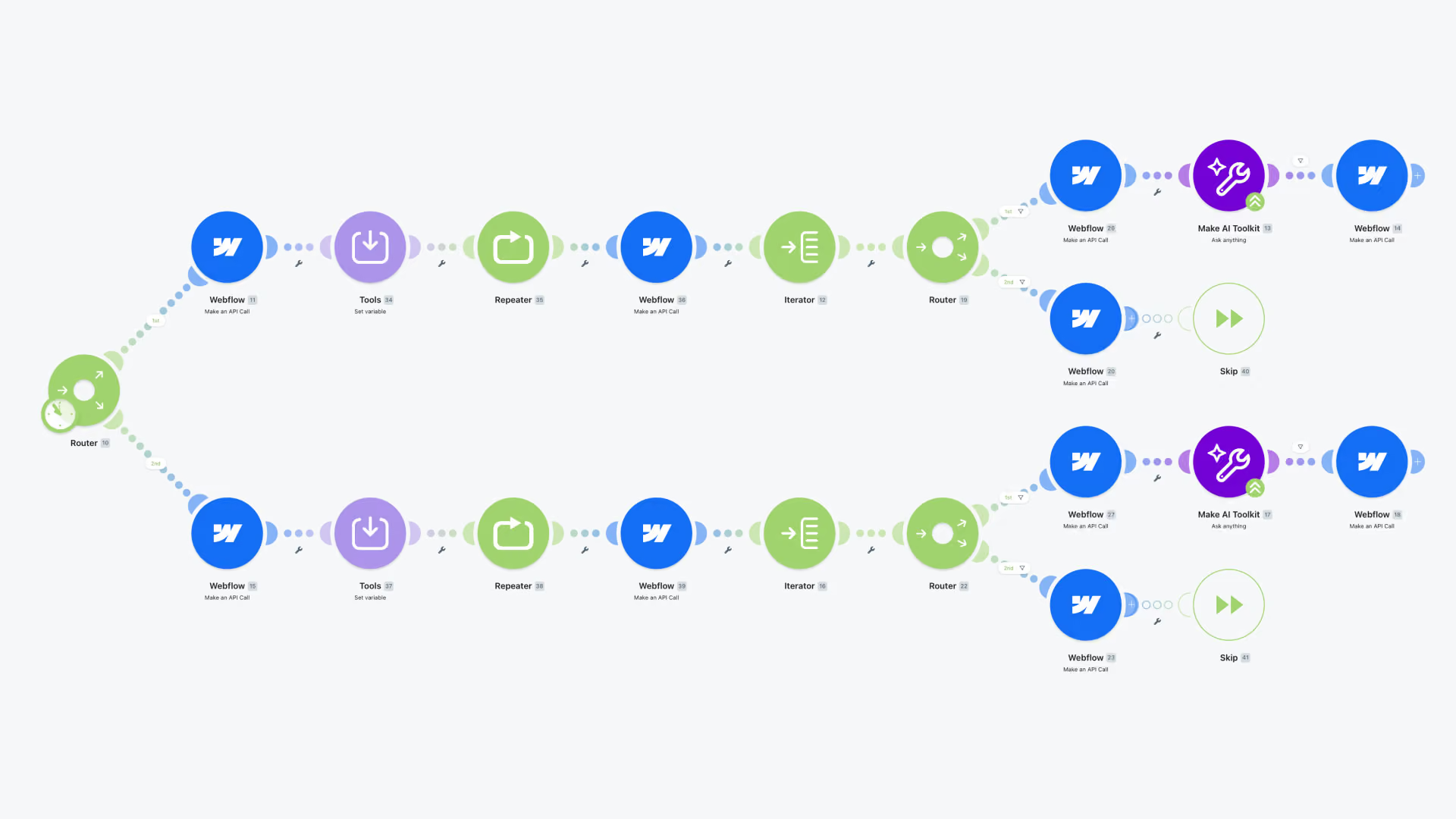
The tools you use to build and run automation programs vary by company. At BORING, we work with Make.com and Zapier, choosing between them based on the complexity of the workflows and the systems they need to connect. We make that choice on a case-by-case basis, and getting that decision right upfront prevents costly rebuilding later.
A consultant is also the right choice when marketing and sales work with different figures. Conflicting reports, disputed attribution, and disagreements over lead quality are symptoms of a measurement architecture that was never properly defined. Solving that requires someone who can sit down with both teams and build a shared foundation.
The third reason is scale. As automation programs grow, so does the complexity of measuring them. More channels, more touchpoints, more data. Without a structured approach to ROI measurement, that complexity piles up, and the signal becomes increasingly difficult to find.
A good marketing automation consultant not only fixes what's broken but builds the infrastructure that makes ROI visible, substantiated, and usable for future decision-making.
Is your automation running, but the ROI picture remains unclear? That's exactly the problem we solve. Get in touch, and we'll look together at where the gaps are.
Further reading


Check it out