Check it out
Webflow Localization vs Weglot vs Linguana: which should you choose?
You want to offer your Webflow website in several languages. The next question is often: which translation tool should we choose? Understandable, but I would first look at what needs to change in each language and who will keep it up to date.

You can handle it inside Webflow or use an additional service such as Weglot or Linguana. The best choice mainly depends on your content and how your team works. Adding a language is one thing. Keeping that version in good shape is the next step.
First decide: translation or localisation?
Translation puts your message into another language. Localisation goes further. Another market may need different examples, images, services or contact details. In that case, you need more than translated text.
List what should be able to differ by language: titles, URLs, CMS content, menus and forms, for example. Who can judge whether the content and tone are right? You will want that person involved.
You can start small with your most important pages too. Better a language version that is properly maintained than a whole site nobody touches after the first translation.
Webflow Localization: manage languages within Webflow
The native solution many people know as Webflow Localization is now offered as Webflow Localize. You manage language versions of pages and CMS content within Webflow. You can also use localised URLs and metadata.
That is useful if you want to keep as much as possible in the same environment. You see the content in the design and can switch between languages. I think that overview matters when making the choice.
Check what your subscription includes. Try a real service page and a blog. What happens when you change the Dutch text? How does a colleague review the translation, and when do you publish it? That is when you discover what the daily work feels like.
Weglot: translations through an additional service
Weglot organises translations through a separate service. The main questions are how its management fits your site and how much content you plan to translate.
Weglot plans include limits on words and languages, among other things. Work out what happens as you add blogs or another language. The plan that fits today should still make sense as you grow.
Test reviewing and updating translations with your own pages. Include forms, external components and text that loads later. It would be a shame to discover after launch that an important element is still in the wrong language.
Linguana: automatic and manual translation
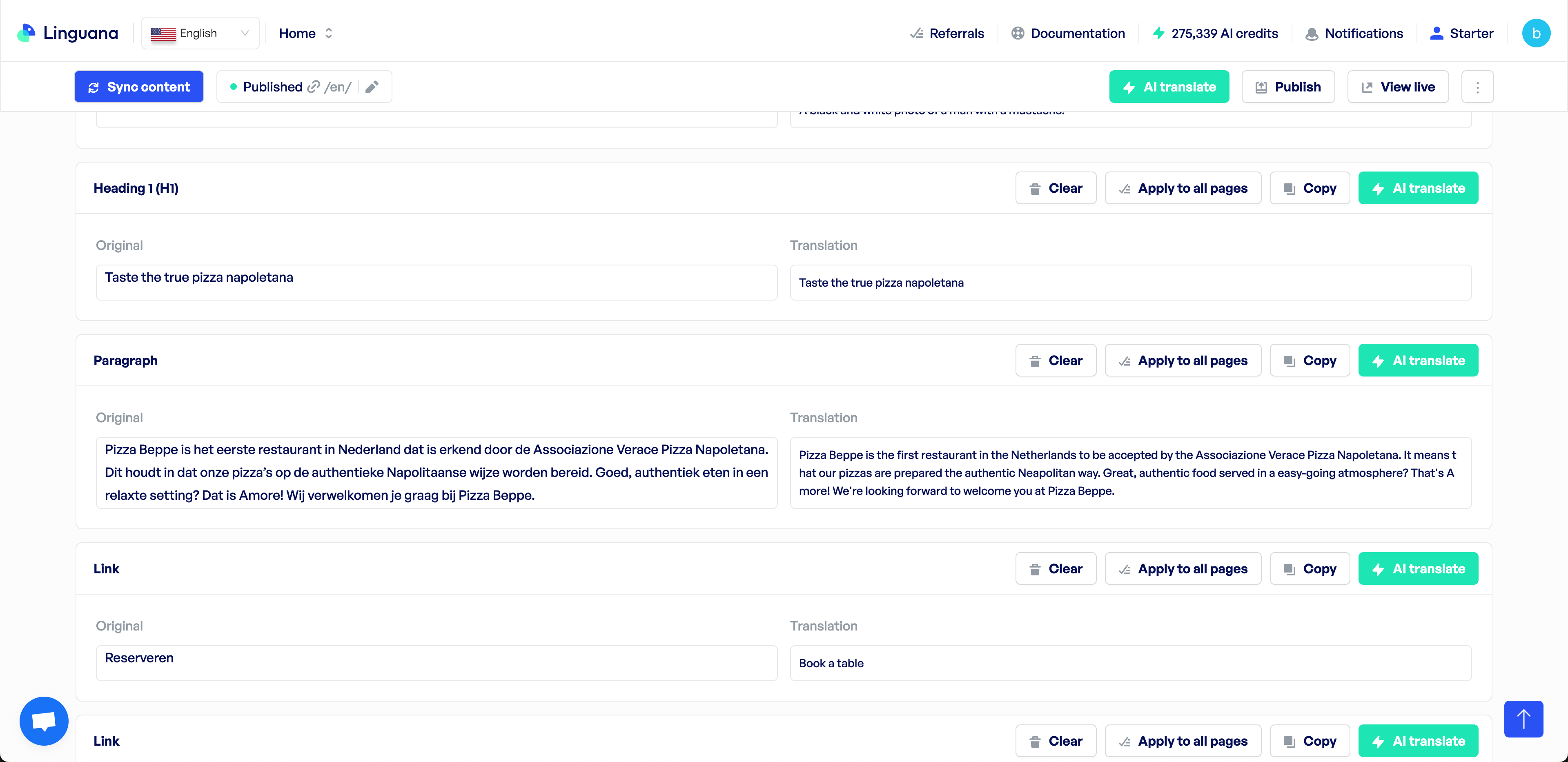
Linguana supports automatic and manual translation. It also offers translated URLs and language versions in subdirectories. It is another way to add multilingual content to a Webflow site.
Here too, I would look at the actual management work. Who makes a correction? What happens when a page changes? Try deleting a page or changing a URL as well. These things will happen after the build.
Also review the terms, support and what you can do with your translations if you switch later. A low starting price is useful, but you want to understand the whole commitment.
Give all three options the same work
Use the same pages for each solution: a service, a blog and a form, for example. Involve the person who will work with it day to day. They will quickly notice which actions feel straightforward and which take too much time.
Look at content review, ease of management, the result in the design, technical behaviour and costs as you grow. Note where extra steps or custom work are needed. That gives you more to compare than the subscription alone.
And review the translation itself. Do specialist terms make sense? Does the tone fit? Does it still say what you intended? An AI translation can read fluently while making the wrong promise.
Does it work for search engines too?
A working language switcher is only part of the check. Each intended language page needs to be accessible and indexable, with the right title and content.
Canonicals and hreflang should match the language structure too. They help search engines understand the preferred version and the language alternatives. Then use Search Console to see which pages receive impressions. If an unexpected language appears, investigate why.
Still deciding? Discuss your multilingual Webflow website with BORING. We will look at your content and how your team works, then choose a suitable solution.